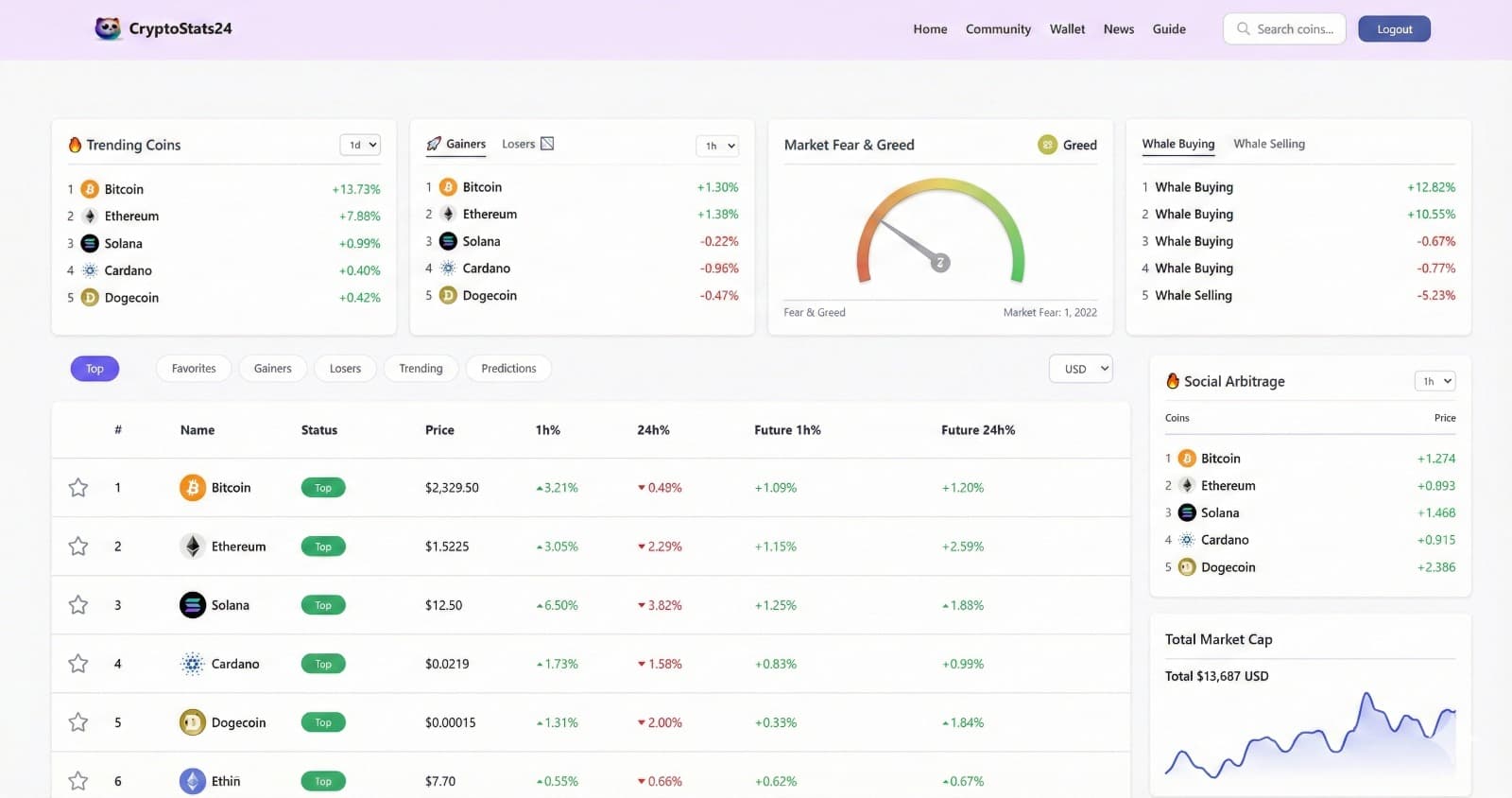
Crypto Prediction & Market Analysis System
A low-latency crypto analytics and forecasting API built with FastAPI and Redis, optimized for real-time dashboards via WebSockets, scheduled data prefetching, and signal enrichment (technical indicators + LLM sentiment).
Problem
The Challenge
Context
Real-time trading dashboards and internal tools need fast, consistent market data and model outputs. Pulling raw price feeds on-demand is slow, rate-limited, and creates unstable latency for user-facing experiences.
User Pain Points
API rate limits and burst traffic cause inconsistent response times.
Dashboards need streaming updates, not polling-heavy endpoints.
Prediction signals are only useful if they are timely, validated, and explainable.
Why Existing Solutions Failed
A basic CRUD API or “fetch on request” approach doesn’t hold up under real-time loads. The system needs caching, scheduling, and streaming primitives to keep latency predictable and throughput stable.
Goals & Metrics
What We Set Out to Achieve
Objectives
- 01Serve market data and analytics with predictable low latency.
- 02Stream live updates to clients via WebSockets.
- 03Use Redis to cache hot paths and reduce upstream API calls.
- 04Prefetch data on a schedule to smooth out load and stay within rate limits.
- 05Enrich signals using technical indicators and optional LLM sentiment context.
Success Metrics
- 01Sub-second median API latency for cached endpoints under typical load.
- 02Reduced upstream API calls via cache hit rate improvements.
- 03Stable WebSocket streaming for real-time dashboard consumption.
- 04Scheduled prefetch keeps data fresh while respecting rate limits.
User Flow
User Journey
Client loads dashboard → subscribes to live updates → API serves cached market state and computed indicators → scheduler refreshes and backfills → enriched signals (optional) surface in UI.
Architecture
System Design
FastAPI service exposes REST endpoints and WebSockets. Redis provides multi-layer caching (raw market data + derived features). APScheduler runs prefetch/backfill jobs. Upstream market data comes from CoinGecko; model/sentiment signals can be generated and cached for downstream consumers.
API Layer
Compute Layer
State & Caching
External Services
Data Flow
How Data Moves
Scheduler pulls upstream market data → caches snapshot → compute indicators/predictions → caches derived signals → API serves cached data and streams deltas to connected clients.
Core Features
Key Functionality
Redis caching for market snapshots
What it does
Caches hot market data and derived features with TTL and predictable reads.
Why it matters
Keeps API latency stable and reduces upstream calls.
Implementation
Keyed caches for assets/timeframes; TTL + refresh-on-schedule; cache-first read path.
Technical indicator pipeline
What it does
Computes indicators (EMA/RSI) for downstream models and dashboards.
Why it matters
Provides consistent feature engineering for predictions and analysis.
Implementation
Deterministic computations from cached candles; store results in Redis for fast reuse.
WebSocket streaming
What it does
Streams live updates to dashboard clients without polling overhead.
Why it matters
Real-time UX with less bandwidth and server churn.
Implementation
Publish updates on refresh; clients subscribe per asset/timeframe.
Scheduled prefetch/backfill
What it does
Prefetches data to keep caches warm and within rate limits.
Why it matters
Prevents thundering-herd spikes and stale dashboards.
Implementation
APScheduler jobs for tickers/candles, backfill windows, and periodic refresh.
Signal enrichment (optional)
What it does
Adds qualitative market context via LLM-based sentiment signals.
Why it matters
Helps interpret model outputs and improves decision support.
Implementation
Generate sentiment summaries and cache them alongside numeric signals.
Technical Challenges
Problems We Solved
Why This Was Hard
Upstream market APIs are rate-limited, while dashboards can spike unpredictably.
Our Solution
Cache-first reads + scheduled prefetch to smooth load and minimize upstream requests.
Why This Was Hard
Polling scales poorly and increases latency variance.
Our Solution
WebSocket streaming with periodic refresh and delta updates.
Why This Was Hard
Models/features can drift if computed from inconsistent data windows.
Our Solution
Single source of truth in cached snapshots; compute pipelines tied to the same candle windows.
Engineering Excellence
Performance, Security & Resilience
Performance
- Redis caching reduces upstream calls and stabilizes p50/p95 latency for dashboard reads.
- Prefetch jobs keep caches warm and reduce cold-start penalties.
- WebSockets reduce repeated REST polling overhead under active dashboard usage.
Error Handling
- Fallback to last-known-good cache on transient upstream failures.
- Timeouts and retries for upstream fetches (where appropriate).
- Graceful degradation: serve cached snapshots even if enrichment is unavailable.
Security
- Secrets and API keys stored in environment variables (not in repository).
- Rate limiting / request validation recommended for public exposure.
- Avoid logging sensitive tokens; structured logging for observability.
Design Decisions
Visual & UX Choices
API-first system
Rationale
Designed to power real-time dashboards and internal tools.
Details
REST for snapshots + WebSockets for streaming deltas; caching makes UX feel instant.
Impact
The Result
What We Achieved
A real-time crypto analytics and forecasting backend with cache-first reads, scheduled prefetching, WebSocket streaming, and extensible signal enrichment—designed for stable latency and production-style constraints.
Who It Helped
Teams building trading dashboards, internal monitoring tools, or market research workflows that need consistent real-time data and predictive signals.
Why It Matters
Demonstrates applied ML engineering with strong systems thinking: latency control, caching strategy, scheduling, and real-time communication patterns.
Verification
Measurable Outcomes
Each outcome verified against reference implementations or test suites.
Sub-second median responses for cached endpoints under typical load
Reduced upstream API call volume via caching and prefetch
Stable WebSocket streaming for dashboard consumption
Reflections
Key Learnings
Technical Learnings
- Cache-first design is essential for stable latency in market-data systems.
- Schedulers are a practical way to respect rate limits while keeping data fresh.
- Streaming updates improve UX while lowering server overhead vs constant polling.
Architectural Insights
- Clear separation between ingestion, caching, compute, and serving layers simplifies scaling and debugging.
- Derived features/signals should be cached to avoid recomputation across clients.
What I'd Improve
- Add stronger observability (metrics/tracing) and public-facing rate limiting.
- Add model monitoring (drift checks) and backtesting evaluation reports.
- Introduce persistence for historical windows (e.g., time-series DB) if needed.
Roadmap
Future Enhancements
Model monitoring + drift alerts and better evaluation dashboards.
Stronger auth and per-user rate limits for public deployment.
Event-driven updates (pub/sub) to coordinate cache refreshes and socket pushes.
Add persistence for long-horizon analytics and backtesting.